
Focused team communication refers to how teams (and their members) communicate about their work. When it is missing, it creates a major challenge for team communication. Therefore, we measure it as part of the teamorama assessment!

Focused team communication refers to how teams (and their members) communicate about their work. When it is missing, it creates a major challenge for team communication. Therefore, we measure it as part of the teamorama assessment!

Due to the global pandemic, a lot of employees have experienced flexibility in regards to theirs working hours a workplace.
Trust is one of the main concepts that enable true teamwork and has shown a strong link to team performance.

Knowledge sharing refers to the frequency, quality and type of proactive exchanges within the team. It’s an essential indicator for building high-quality relationships in teams and smooth teamwork. Sharing knowledge is also related to active problem-solving. Therefore, we measure it as part of the teamorama assessment!

Organizations often define specific communication media & methods for their employees. However, on a daily basis, it’s your individual choice if you want to send an email, make a quick call, or leave a chat message. On a team level, such decisions have a profound effect on team performance as well as individual members’ well-being. So, we measure it as part of our teamorama assessment!

Scientifically, the concept of how much team members stick together is called team cohesion. It is a shared attraction and sense of pride among team members and is widely regarded as an essential aspect of overall team functioning, and is also one of the earliest and most widely studied team constructs.
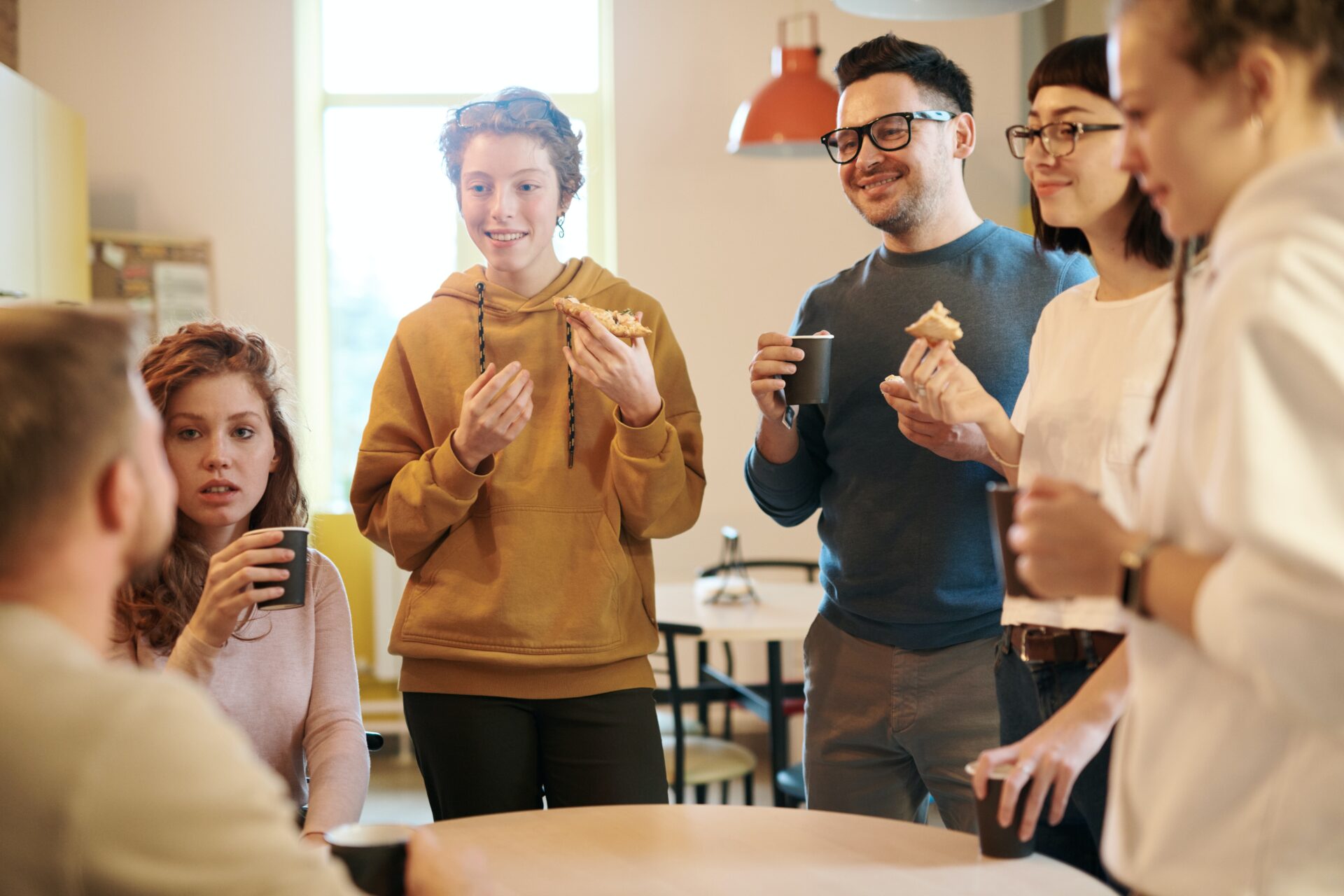
Spontaneous communication refers to how teams (and their members) communicate in informal settings, usually unplanned or unexpected. Such communication facilitates the creation of a shared context and decreases the probability of misunderstandings and conflicts in the team. Therefore, we measure it as part of the teamorama assessment!
Rules increase performance via shared mental models and justice Explicit team rules develop a shared understanding of availability incorporating individual and team needs (Baumgaertner & Hartner-Tiefenthaler, 2022). When reflecting on team processes and collectively defining team rules, we argue that shared mental models for working together flexibly are developed within the team connecting team reflection...
Team building encompasses a variety of events, from an in promptu after-work social activity to a professionally facilitated event.